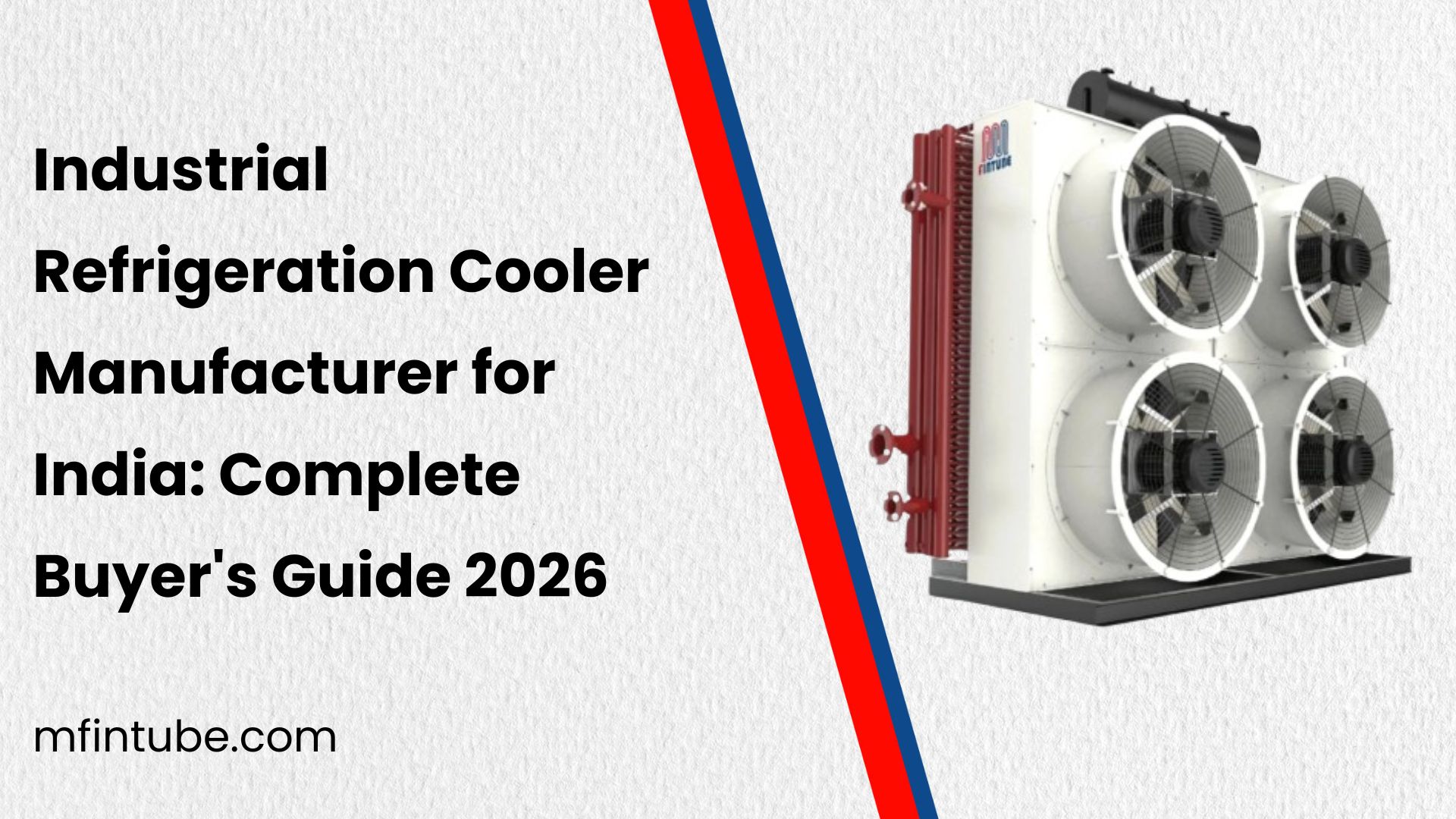
Industrial Refrigeration Cooler Manufacturer for India: Complete Buyer's Guide 2026
Introduction
India's industrial sector depends on reliable cooling systems to maintain production efficiency, protect sensitive equipment, and control operating temperatures. Industries such as food processing, chemicals, pharmaceuticals, manufacturing, power generation, and data centres require dependable cooling solutions to manage heat generated during continuous operations. As industrial facilities expand, selecting the right industrial refrigeration cooler manufacturer for India becomes an important decision for engineers, plant managers, and procurement professionals.
Industrial refrigeration is not limited to maintaining low temperatures. It also involves heat rejection, process fluid cooling, vapour condensation, and temperature control under demanding operating conditions. Manufacturers must therefore consider factors such as cooling capacity, ambient temperature, water availability, energy consumption, and equipment reliability before choosing a suitable system.
MFINTUBE offers heat-transfer and industrial cooling solutions, including dry coolers, adiabatic dry coolers, refrigeration condensers, air coolers, and customised cooling equipment. Its product portfolio supports various industrial applications, including process cooling, refrigeration, power generation, and data centre cooling.
Industrial Refrigeration Market Overview and Challenges in India
Industrial cooling requirements vary according to the process, location, operating temperature, and production capacity. Indian industries must address several challenges when selecting refrigeration equipment.
High ambient temperatures: During summer, high outdoor temperatures can reduce heat rejection performance. Cooling equipment must be designed for the actual site conditions rather than average annual temperatures.
Water scarcity: Conventional evaporative cooling systems may require substantial quantities of water. Facilities operating in water-stressed regions increasingly evaluate dry cooling and adiabatic cooling alternatives.
Rising energy costs: Fans, compressors, pumps, and other refrigeration components contribute to operating expenses. Appropriate equipment sizing and efficient heat-transfer design can help control electricity consumption.
Process reliability: Unexpected cooling failures may interrupt production, affect product quality, or cause equipment overheating. Reliable system design and preventive maintenance are essential.
Industry-specific requirements: Food processing may require strict temperature control, while chemical plants may need corrosion-resistant materials and compatibility with specialised process fluids.
Types of Industrial Refrigeration and Cooling Solutions
An industrial refrigeration cooler manufacturer for India may offer different systems depending on whether the application requires direct refrigeration, fluid cooling, or heat rejection.
|
|
|
|
|
|
|
|
|
|
|
|
|
|
|
|
|
|
|
|
|
|
|
|
|
|
|
|
|
|
|
|
|
|
|
Understanding Industrial Cooling Products and Technical Specifications
Before purchasing equipment, buyers should understand how different products perform and which technical specifications influence their suitability.
1. Dry Coolers
Dry coolers transfer heat from circulating water, glycol mixtures, oil, or other compatible process fluids to ambient air through a heat exchanger. Because the process fluid remains separate from the outside air, this arrangement can reduce direct fluid contamination and avoid evaporative water consumption during normal dry operation.
MFINTUBE provides dry cooling solutions for applications such as process cooling, engine cooling, oil cooling, generator cooling, transformer cooling, and data centres.
2. Adiabatic Dry Coolers
Adiabatic dry coolers combine air-based heat rejection with evaporative pre-cooling under suitable conditions. This approach can improve cooling performance when ambient temperatures are high, while reducing water consumption compared with systems that rely continuously on evaporation.
The actual savings depend on climate, operating hours, system design, and water-control strategy. These factors should be assessed during equipment selection.
3. Industrial Condensers
Condensers remove heat from refrigerants or process vapours to convert them into liquid. Industrial applications may involve ammonia, suitable fluorinated refrigerants, carbon dioxide, ethanol, or other process vapours, depending on the equipment design.
4. Customised Mega-Capacity Coolers
Large industrial facilities may require cooling equipment designed for substantial heat loads and demanding operating conditions.
MFINTUBE's customised MFIN-MEGA Fin Cooler and process-cooling product specifications list a capacity range of 1,000 kW to 5,000 kW per unit for the relevant configurations. The published material options include aluminium-magnesium alloy, aluminium, or copper fins, with stainless-steel or copper tubes depending on the product. AC and EC fan options are also listed. These specifications should not be assumed to apply to every product in the company's portfolio.
Industry-Specific Applications of Industrial Cooling Systems
Food Processing and Cold Storage
Food processing facilities use refrigeration for chilling, freezing, cold storage, and temperature-sensitive production operations. Dairy processing, beverage manufacturing, meat processing, and packaged food production may require different cooling temperatures and capacities.
Industrial refrigeration equipment should be selected according to product temperature requirements, heat loads, hygiene considerations, and operating schedules. Evaporators, condensers, and compatible heat exchangers can form part of an integrated refrigeration system.
Chemical and Process Industries
Chemical manufacturing often involves exothermic reactions, temperature-sensitive processes, and the circulation of specialised fluids. Inadequate cooling can affect process stability, product quality, and plant safety.
Cooling equipment must be selected according to the fluid's chemical properties, operating pressure, temperature, and heat load. Appropriate tube materials, fin materials, and protective coatings may be necessary for demanding environments.
HVAC and Commercial Infrastructure
Large commercial buildings and industrial facilities require cooling to maintain suitable indoor temperatures and support equipment operation. Chilled-water coils, heat exchangers, and other cooling components can be integrated into HVAC systems.
Selection should account for airflow, entering and leaving fluid temperatures, pressure drop, available installation space, and seasonal operating conditions.
Data Centers and Power Plants
Data centers generate substantial heat from servers and electrical equipment, making reliable thermal management essential. Power plants also require cooling for applications involving generators, transformers, engines, and other equipment.
MFINTUBE lists dedicated cooling solutions for data centres and power-related applications, including dry coolers, customised mega-capacity coolers, and related heat-transfer equipment. The appropriate arrangement depends on the facility's heat load, redundancy requirements, environmental conditions, and operating strategy.
How to Choose an Industrial Refrigeration Cooler Manufacturer in India
Selecting a manufacturer requires more than comparing equipment prices. Buyers should evaluate the following factors.
1. Cooling capacity
Calculate the actual heat load using process flow rates, fluid properties, inlet and outlet temperatures, and operating conditions. Include suitable design allowances based on engineering requirements rather than relying on arbitrary oversizing.
2. Material of Construction (MOC)
Evaluate tube and fin materials according to fluid compatibility, corrosion exposure, temperature, pressure, and expected service life. Stainless steel, copper, aluminium, and aluminium-magnesium alloys may be appropriate for different applications.
3. Energy efficiency
Review fan power, pressure drop, heat-transfer performance, control systems, and expected annual energy consumption. EC fans and variable-speed controls may improve efficiency when correctly selected and operated.
4. Site conditions
Consider maximum ambient temperature, humidity, dust levels, noise restrictions, installation space, and maintenance access.
5. Maintenance and lifecycle costs
Evaluate cleaning requirements, spare-part availability, inspection schedules, energy consumption, and expected service life. The lowest initial quotation may not deliver the lowest total cost of ownership.
6. Customization capabilities
A manufacturer should be able to assess unusual fluid properties, large heat loads, material requirements, and space constraints. Ask for engineering calculations and a clearly defined technical scope.
7. Documentation and compliance
Check applicable pressure-equipment requirements, electrical safety provisions, refrigerant-related regulations, and relevant industry standards. Compliance obligations depend on the equipment type, operating conditions, and installation.
Industrial Refrigeration Cooler Cost Considerations in India
The cost of industrial refrigeration equipment varies considerably according to its design and application. A compact cooling coil, a standard dry cooler, a specialised condenser, and a multi-megawatt cooling system cannot be compared on price alone.
Major cost factors include cooling capacity, heat-exchanger surface area, tube and fin materials, fan selection, operating pressure, fabrication complexity, instrumentation, controls, and installation requirements.
When comparing quotations, evaluate both capital expenditure and expected operating costs.
Why Consider MFINTUBE for Industrial Cooling Requirements?
MFINTUBE specialises in fin-tube heat exchangers and offers cooling solutions for industrial refrigeration, process applications, HVAC, power generation, and data centers. Its product range includes dry coolers, adiabatic dry coolers, condensers, industrial air coolers, heating and cooling coils, and plate heat exchangers.
The company also lists customised mega-capacity cooler configurations, multiple fin and tube material options, and different fan arrangements for relevant products. These capabilities may be useful for buyers seeking equipment tailored to particular process conditions rather than a standard off-the-shelf design.
When evaluating MFINTUBE, buyers should share their cooling duty, fluid details, operating temperatures, ambient conditions, and installation requirements. This information helps the technical team assess the appropriate equipment configuration.
Conclusion
Choosing the right industrial refrigeration cooler manufacturer for India requires a clear understanding of process requirements, heat loads, material compatibility, energy consumption, and long-term maintenance needs. Dry coolers, adiabatic coolers, condensers, and refrigeration evaporators each serve different purposes, so the equipment should match the application's actual operating conditions.
MFINTUBE offers a range of heat-transfer and industrial cooling products for sectors including refrigeration, food processing, chemicals, power generation, and data centers. Businesses planning a new installation or upgrading an existing cooling system can contact MFINTUBE to discuss their technical requirements and identify suitable options.
Frequently Asked Questions
1. What does an industrial refrigeration cooler manufacturer do?
An industrial refrigeration cooler manufacturer designs or supplies cooling equipment used to remove heat from process fluids, refrigerated spaces, machinery, and industrial systems. Depending on its portfolio, the manufacturer may offer dry coolers, condensers, evaporators, cooling coils, and customised heat exchangers.
2. How do I select the right industrial refrigeration cooler in India?
Start by identifying the required cooling capacity, process fluid, inlet and outlet temperatures, ambient conditions, available utilities, and installation constraints. Compare equipment performance, material compatibility, energy consumption, maintenance needs, and manufacturer support before making a decision.
3. What is the difference between a dry cooler and an adiabatic dry cooler?
A dry cooler transfers heat to ambient air without evaporative water consumption during normal dry operation. An adiabatic dry cooler can use water to pre-cool incoming air under suitable conditions, potentially improving performance during hot weather.
4. Which materials are used in industrial cooling equipment?
Common materials include stainless steel, copper, aluminium, and aluminium-magnesium alloys. The correct selection depends on the process fluid, corrosion conditions, temperature, pressure, mechanical requirements, and equipment design.
5. Can industrial coolers be customised for high-capacity applications?
Yes. Suitable manufacturers can engineer cooling equipment according to heat load, process conditions, materials, fan configuration, and site constraints. MFINTUBE lists customised MFIN-MEGA Fin Cooler configurations for relevant high-capacity applications.
Get in Touch with MFINTUBE
Looking for an industrial refrigeration cooler manufacturer for India for your next industrial project? Contact MFINTUBE to discuss your cooling requirements, explore suitable product configurations, and request technical information or a project-specific quotation.
Visit the official MFINTUBE website to explore its industrial cooling solutions and submit an enquiry.
Read More: Industrial Refrigeration Cooler Manufacturer for India: Complete Buyer's Guide 2026