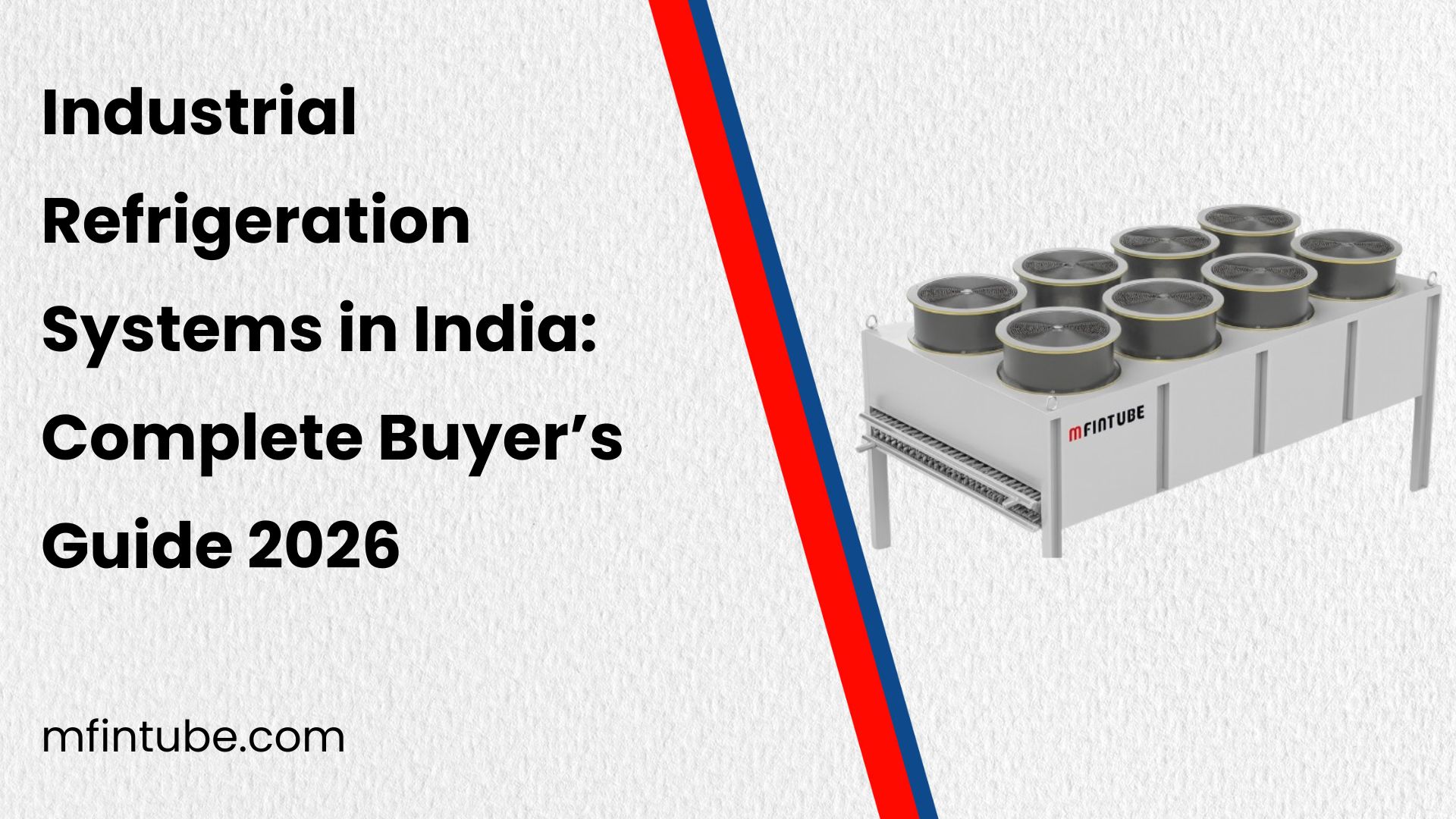
Industrial Refrigeration Systems in India: Complete Buyer’s Guide 2026
India’s industrial refrigeration sector is expanding rapidly, driven by growth in food processing, pharmaceuticals, chemicals, cold chain logistics, data centres, and process industries. Rising temperatures, stricter food safety norms, energy cost pressures, and water scarcity are reshaping equipment choices. Buyers can no longer rely solely on traditional systems; they need solutions that balance capacity, efficiency, reliability, and total cost of ownership under Indian ambient conditions.
Market Overview and Industry Challenges in India
India’s industrial refrigeration and related cooling market continues to grow, supported by investments in cold storage, processed foods, pharmaceuticals, and data centres. Demand is fuelled by government cold-chain initiatives, rising organised retail and quick commerce, and stricter temperature-control requirements for food and pharma products.
Several India-specific challenges influence system design and selection:
-
High ambient temperatures:
Summer dry-bulb temperatures frequently exceed 40–45°C in many regions, reducing the effectiveness of pure air-cooled systems and increasing condenser pressure and energy consumption.
- Water scarcity:
Many industrial zones face restricted water availability or high water costs, making traditional evaporative cooling towers less viable or subject to operational limits.
- Energy costs and reliability:
Electricity is a major operating expense. Systems must deliver high efficiency and, where possible, free-cooling capability.
- Food safety and hygiene norms:
FSSAI and related standards demand reliable temperature control, cleanability, and materials suitable for food-grade environments.
- Chemical and process requirements:
Corrosive atmospheres, specific fluid temperatures, and continuous operation demand robust materials of construction (MOC) and custom engineering.
- Space, noise, and installation constraints:
Urban and expanding industrial sites often limit footprint and require quieter operation.
These factors push buyers toward closed-loop dry coolers, adiabatic systems, hybrid solutions, and high-performance evaporators and condensers designed for Indian conditions.
Types of Solutions Available
Industrial refrigeration systems typically consist of compressors, evaporators/air coolers, condensers or heat rejection equipment, controls, and auxiliary components. Heat rejection is often the critical decision point in India.
Common heat-rejection and cooling approaches include:
- Traditional evaporative cooling towers / open systems
- Dry coolers (air-cooled heat exchangers)
- Adiabatic coolers (dry coolers with pre-cooling pads or spray)
- Evaporative condensers
- Hybrid / free-cooling systems
Comparison Table: Dry Cooler vs Adiabatic vs Evaporative vs Traditional
|
|
|
|
|
|
|
|
|
|
|
|
|
|
|
|
|
|
|
|
|
|
|
|
|
|
|
|
|
|
|
|
|
|
|
|
|
|
|
|
|
|
|
|
|
|
|
|
Dry and adiabatic solutions are gaining strong traction in India because they sharply reduce or eliminate water use while still delivering acceptable process temperatures for many applications.
Key product categories relevant to Indian buyers:
-
Dry coolers and remote radiators:
Closed-loop systems that reject heat to ambient air. Available in horizontal, vertical, V-type, and mega configurations. Suitable for process fluid cooling, generator/engine cooling, transformer oil, and free-cooling loops.
- Adiabatic dry coolers:
Dry coolers fitted with adiabatic pads or controlled spray systems that pre-cool inlet air only when ambient temperatures are high. This boosts capacity and allows lower fluid temperatures with minimal water use.
- Air-cooled and evaporative condensers:
For ammonia (NH3), HFC, CO2, and other refrigerants. Critical for industrial refrigeration plants in food and process industries.
- Industrial air coolers / evaporators:
Ammonia, HFC/glycol, and chilled-water/brine units for cold stores, processing rooms, and blast freezers. Designed for low temperatures (down to –30°C or lower) and high air-flow.
- Specialised coils:
Chilled-water, hot-water, steam, thermic-fluid, and process coils.
Industry-Specific Applications
Food Processing
Cold stores, dairy, meat, poultry, seafood, fruit & vegetable processing, and ice-cream plants require precise temperature control and hygienic equipment. Ammonia air coolers and evaporators, combined with efficient condensers or dry/adiabatic heat rejection, help maintain product quality, reduce energy use, and meet food-safety standards. Closed-loop systems minimise water contamination risks.
Chemical Industry
Process cooling, reactor temperature control, solvent recovery, and corrosive fluid handling demand robust MOC (SS tubes, special coatings) and reliable heat rejection. Dry and adiabatic coolers are preferred where water quality or availability is poor.
HVAC Systems
Large commercial buildings, hospitals, and industrial HVAC often use chillers with dry or adiabatic heat rejection to reduce water consumption and operating costs, especially in water-stressed regions.
Process Industry & Others
Power generation (remote radiators, generator cooling), data centres (high-capacity dry/adiabatic coolers for free cooling and low WUE), pharmaceuticals, green hydrogen, oil cooling, and transformer cooling all benefit from customised fin-tube solutions that prioritise energy efficiency and low maintenance.
Key Selection Criteria
-
Capacity calculation factors
Base load + peak ambient conditions + future expansion. Account for high Indian design temperatures (often 40–48°C dry-bulb). Oversizing for pure dry coolers or using adiabatic boost can be more economical than continuous oversizing.
- Material of Construction (MOC)
Match tubes, fins, headers, and casing to the fluid, ambient corrosivity, and hygiene needs. AL-MG fins and special coatings extend life in coastal or industrial atmospheres. Stainless options for food and chemical duty.
- Energy efficiency parameters
Approach temperatures, fan power (prefer EC fans where possible), free-cooling hours, and overall system COP/PUE. Adiabatic activation only on peak days keeps annual energy and water use low.
- Maintenance & lifecycle cost
Dry systems have the lowest ongoing maintenance. Factor in cleaning access, fan reliability, pad replacement (for adiabatic), and expected service life (15–20+ years with proper design).
- Compliance and standards
Food-grade requirements, pressure-vessel codes where applicable, noise regulations, and any local water-use restrictions. Prefer suppliers experienced with Indian site conditions and export-quality manufacturing.
Case Study
Manufacturers with proven large-scale experience (including data-centre deployments exceeding 100 MW cumulative capacity and process installations across India and export markets) demonstrate the ability to deliver reliable mega-size dry and adiabatic coolers under demanding conditions. Custom units with AL-MG fins and special coatings have supported continuous operation in high-ambient, water-constrained sites—validating the shift toward these technologies.
Why MFINTUBE is a Strong Choice
MFINTUBE stands out through multi-MOC capability, mega-size manufacturing, AL-MG fin options, Heresite and other coatings, and hands-on experience in data centers, power plants, process cooling, and industrial refrigeration. The company offers customized design using advanced thermal software, reduced lead times, and solutions tailored to Indian ambient and water realities. Whether the requirement is an ammonia air cooler for a food plant, a freon condenser, a large dry cooler for free cooling, or an MFIN-MEGA adiabatic unit, the focus remains on efficiency, durability, and application-specific engineering.
FAQ Section
1. What is the most suitable heat-rejection system for water-scarce industrial sites in India?
Dry coolers or adiabatic coolers. Dry coolers use zero water; adiabatic systems use water only during peak ambient periods.
2. Can dry coolers work effectively in 45°C+ Indian summers?
Yes for higher fluid temperatures or free-cooling loops. For lower temperatures, adiabatic assistance or hybrid designs maintain capacity.
3. What refrigerants are commonly used in Indian industrial refrigeration?
Ammonia remains dominant for large food and process plants. HFCs, HFOs, CO2, and glycol secondary loops are also widely used depending on application and regulations.
4. How important is fin material (AL-MG) in Indian conditions?
Very. AL-MG fins offer better corrosion resistance than standard aluminium in humid, coastal, or industrial atmospheres, extending coil life.
5. What capacity range can custom manufacturers typically handle?
From tens of kW to multi-MW megawatts, including containerised and skid-mounted packages.
Conclusion
Selecting the right industrial refrigeration system in India requires balancing high ambient temperatures, water constraints, energy costs, hygiene needs, and long-term reliability. Dry coolers, adiabatic systems, and high-performance fin-tube evaporators and condensers offer practical, efficient answers for food processing, chemicals, HVAC, process industries, and data centers.
CTA
For a detailed technical evaluation, capacity selection, or custom quotation, contact MFINTUBE for a free consultation, product brochure, or site-specific proposal. Visit www.mfintube.com or email sales@mfintube.com to discuss your project requirements and move forward with confidence in 2026.
Read More: Industrial Refrigeration Systems in India: Complete Buyer’s Guide 2026